
An essay on fear, distorted perception, and the judiciary of the inner world
(inspired by the film Beau Is Afraid, written and directed by Ari Aster)
There are films one does not simply watch, but undergoes. Beau Is Afraid is such a work — less a story than a psychological mode that spreads, twists, and ultimately collapses into itself.
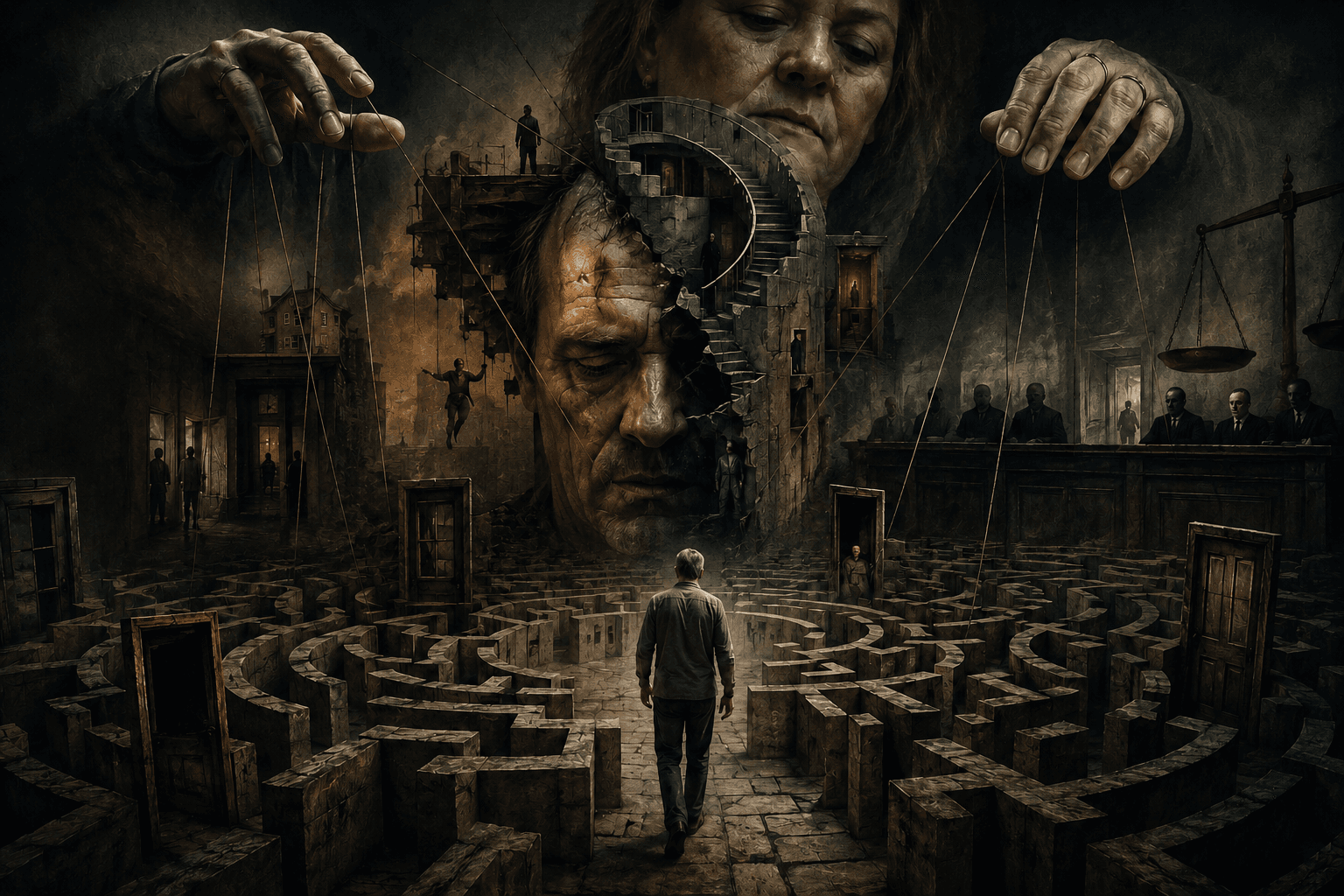
As Beau wanders through a grotesquely distorted world, a labyrinth emerges — not one made of corridors, but of inner landscapes. What unfolds here is not a narrative in the classical sense, but the protocol of a consciousness that has put itself on trial.
WHAT SEEMS TO BE, IS TO THOSE TO WHOM IT SEEMS TO BE [...] (William Blake)
This sentence is not a poetic exaggeration, but a precise description of psychological reality. “We don’t see things as they are, we see them as we are.” (Anaïs Nin) Perception is not a window — it is a filter. And that filter is shaped by memories, conditioning, fears, and undigested emotions.
Beau lives in a world permeated by fear. But this fear does not come from the outside. It seeps through every scene like an invisible poison — until it becomes clear: it is the very substance of his inner world, crystallizing into voices, threats, and absurd coincidences that appear to conspire against him.
What we do not make conscious returns to us as fate (shadow projection)
With this thesis, Carl Gustav Jung described a central psychological mechanism. When inner conflicts are repressed, they do not disappear. They merely change their form. They move outward, disguised as the world: as a seemingly providential turn that appears hostile, as relationship patterns that repeat themselves, as conflicts that exceed their own logic.
Suddenly, it is “the others” who are difficult. The circumstances that appear unjust. Life itself that feels contradictory. Yet in truth, it is often an inner fracture that is being mirrored in the external world.
What is repressed does not remain silent. It becomes part of an invisible judiciary in which the subject passes judgment on itself without knowing it. What is not integrated continues to act from the shadow — subtle, distorted, and often destructive. Its activity can be recognized in certain patterns: conflicts repeat as though they were following a script. In others, we see what we secretly admire or what we cannot tolerate in ourselves.
The Mother Complex and the Judiciary of the Inner World
In Beau Is Afraid, this dynamic culminates in a Kafkaesque finale that inevitably recalls The Trial. A trial is taking place, and as in the work of Franz Kafka, it remains unclear who is actually passing judgment. The world? The mother? Or one’s own conscience?
From the very outset, the film points to this inner structural conflict: Beau unconsciously refuses to visit his mother. Although the journey appears outwardly trivial, it becomes psychologically an almost insurmountable threat. Anxiety permeates dreams and fantasies and creates paranoid distortions and nightmare-like scenes.
His fears therefore do not appear random or situational. Rather, they resemble the return of an early inner terror that has never been processed. The mother is less a biographical figure than a psychic gravitational core of guilt, control, dependence, fear, and emotional overwhelm. Even the mere thought of the visit reactivates this archaic inner state of psychological emergency.
The hallucinatory obstacles, absurd coincidences, and escalating catastrophes appear, from a psychological perspective, as expressions of an inner resistance against the encounter itself. His psychic system seems to do everything in its power to delay or render impossible the confrontation with the mother. The external nightmare thus becomes an expression of an internal defense mechanism.
And so life itself becomes a tribunal. The real tragedy does not lie in external absurdity, but in the fact that Beau cannot distance himself from his mental images. He experiences an overwhelming world of fear and does not recognize it as part of himself, but as absolute reality.
The dynamics of this inner judiciary follow a claustrophobic logic: on an unconscious level, the ego is simultaneously accused and judge. The world functions as an evidentiary space. Feeling replaces evidence.
While Kafka managed to shift the bureaucracy of the absurd from the inside to the outside, the tribunal in Beau is fully internalized. Bureaucracy has become psychic. Beau himself is no longer an observer within this system, but its raw material. He is the site where the tribunal is enacted.
The real tragedy lies in the fact that he does not recognize the instances of this inner court as his own creations. He experiences them as the world. And the world responds accordingly: consistently, relentlessly, seemingly logically.
Yet this logic is circular. What appears as an external threat is often the return of what could not be integrated internally. The world does not judge Beau — it mirrors the judgment that has already been pronounced within him.
The Nightmare Without an Ending
Integration, under these conditions, would not be a state of harmony, but the dissolution of the unconscious judiciary itself: the capacity to recognize the inner instances as parts of one’s own psychic structure, rather than experiencing them as autonomous forces.
Perhaps, in this case, the real drama does not lie in the cruelty of the world, but in the inability to recognize the tribunal as one’s own. And this is precisely the challenge — not only for Beau, but for every human being: the ability to distinguish between what is, and what acts within us.
Becoming whole does not mean being freed from all fear forever. It means recognizing it. Not the absence of contradictory feelings, but the ability to give them space without being governed by them.
Wholeness is not a harmonious state. It is a process. Often a painful one, because it requires us to encounter ourselves – especially the parts we have long suppressed and avoided.
Perhaps wholeness begins at the point where we start to question the absolute truth of our own perception.
_______________________________________________________________________________________
♡ Note: The content of this blog has been carefully created and is intended for inspiration, self-reflection, and personal development. It does not constitute medical or psychotherapeutic advice or treatment and does not replace them. If you are experiencing health-related or psychological concerns, please consult a qualified professional.